All projects: Gel, Jobs, Gootodo, Games, Uncle Mark, Goovite, Blog, Bit Literacy
Gel Challenge 2009 finalists
I'm happy to announce the finalist entries in the first Gel Challenge, which issued a call for entries around the theme of "listening." (See the guidelines.)
I'm impressed with the range of ideas expressed in our four finalists - and I hope that, after exploring the entries, you'll leave a comment stating which entry you think should win the Challenge!
Dear Driver, by Erik Fabian and Josh Weinstein
Summary: a project to improve the understanding between cyclists and motorists.
More Info
Gel Voice, by Jacqueline Corbelli and Jim Anderson
Summary: proposal to help children shape their future through listening, using technology and problem-solving.
More Info
MeWe, by Rahul Pramanik
Summary: proposal for experiential tools to improve listening, and relationships, within couples.
More Info
Camera, by Jennifer Konig
Summary: exploration of the act of listening, as captured in photographs.
More Info
Who should win? Post a comment below naming your favorite entry - this is your chance to weigh in on which entry should be shown on-stage at Gel 2010.
The reality of a Times bestseller:
After expenses and everyone else was paid, I netted about $26K of my $50K advance for this book, which is believe it or not very good -- most authors are lucky if they can make 10% profit on any book. This should also shut up everyone who says all bestselling authors make millions -- most of us don't.
The patient experience and Matt Haughey
Matt Haughey's description of his "adventure in brain tumors" is worth reading. Matt is well-known as the founder of MetaFilter, one of the most successful and vibrant online communities ever created, and well-loved as an all-around good and positive person (which comes through in the experience of using MetaFilter).
Matt's story about his hospital visit is instructive on two levels. First, his experience mirrors what is said all too often about the hospital patient experience: medical staff, even if capable and effective, don't create an efficient or especially comfortable environment. Matt's description is amazingly clear, given how recent the events were when he wrote this:
The days in the hospital didn't go by so much as a blur as they did a smear. I was either asleep, passed out and seizing, lethargic, and very briefly completely awake each day as an army of medical professionals grilled me with a couple dozen identical questions and eventually life altering decisions were presented to me when I had been awake for all of 30 seconds.I came away from this experience feeling the OHSU hospital in Portland continues to impress me with its amazing staff, but that the process of dealing with patients could be done in a more efficient manner. I know they all sort of kept an internal log of my story but to constantly be asked the same things by different groups of people and then not know who is your main decision maker was a challenge. Given my state of sickness and exhaustion, I felt like what an elderly man might feel like in the medical system. I had trouble understanding what people were saying as they woke me from sleep, I was constantly poked and prodded without descriptions of what results entailed, I literally wanted to "phone a friend" when those surgeons asked me in the early morning hours what I wanted to do.
The other takeaway from Matt's "adventure" is the role social media played. Anil Dash invited the Twitter universe to post nice things about Matt with the hashtag #matthowielove and over a thousand people quickly typed up posts. (As I said, Matt is well-known and well-loved, a potent combination!) Matt writes about his experience seeing the posts on Twitter:
It was all quite a surprise and I felt awed and loved and supported by everyone's good thoughts and kindness towards me. As I shut my laptop I feel like I just crowd-surfed the entire internet as they held me high above and as cliched as that sounds it was a very good feeling to sleep to.
Very few people could command a thousand get-well messages on Twitter, but it's worth noting that social media can be a real force for healing... especially in challenging environments like a hospital room.
It also raises an interesting question: If you were head of quality-of-care for a major hospital, which would you invest in - improving the efficiency and empathy delivered by clinical staff, or improving your patients' access and exposure to social media during their visit? Of course it's not an either-or decision, but worth considering the relative merits of those two elements of Matt's experience.
(These are some of the issues we explored at Gel Health, by the way.)
Customer experience weekend reading
Some worthwhile reading on Friday afternoon:
• Which is more useful? Google's links or the actual home page? asks Jason Fried. I hope he means it as a rhetorical question - of course Google's links are more useful... most corporate homepages have horrendous design. The issue is that Web designers have a huge screensize to fill up, and lots of bandwidth available, and a brand to communicate. Who can make a career as a designer with a few underlined text links?
• Meanwhile, David Pogue exposes a billing scam at Verizon, which penalizes customers $2 for pressing the wrong button on the phone (which is designed for just such mistakes). As Pogue asks, isn't there a better model out there for a company that wants to treat customers well?
• On the brighter side, the Whitney museum here in New York relaunched its website - and delivered the #1 most important thing a museum website needs: hours, location, and admission all prominently displayed on the homepage. I understand there are other sections on the site, too, but now that we know where and when we can get to the museum, people might actually get to the museum - y'know, that place away from the computer screen where you walk into a building and look at stuff.
Here's to more customer-centered thinking... happy weekend!
Hipsters go back to the 1890s
A few weeks ago on my Twitter feed (read it here) I wrote...
Hipsters can't decide if they live in the 1950s, the 1920s, or the 1890s. Just choose a decade and go with it!
Today the NYT reports that late 19th-century decor and dress is [sic] back in fashion:
As with home design, where curio cases, taxidermy and other stylish clutter of the Victorian era have been taken up by young hipsters, many of today's popular men's styles have their roots in the late 19th century. There are the three-piece suits once favored by mustachioed Gilded Age bankers; the military greatcoats and boots of Union officers; and the henley undershirts, suspenders, plaid flannel shirts and stout drill trousers worn by plain, honest farmers.
Next time you see someone playing Victorian dress-up, ask them - since you're straight out of 1890, can you tell me who the president was then? (Answer here.)
Stanford on multitasking
At my bit literacy talks I often encourage people to do one thing at a time.
But what about multitaskers, the people who love to brag about how they're wired differently from mere mortals and can accomplish several things at once? Stanford professor Clifford Nass reached this conclusion after researching the topic:
"They're suckers for irrelevancy," said communication Professor Clifford Nass, one of the researchers whose findings are published in the Aug. 24 edition of the Proceedings of the National Academy of Sciences. "Everything distracts them."
Do one thing at a time.
Seven suggestions for messy times: notes from a talk I gave last week to several dozen heads-of-school.
Why the shiny thing is everywhere
Why do so many websites have the same shiny thing that users don't want?
Company D saw something shiny on Company C's website, so they launched the same thing.
Company C had the shiny thing because they had seen it on Company B's website, and so they copied it.
Company B had the shiny thing because they had seen it on Company A's site.
Company A did it because someone thought the shiny thing sounded cool.
But no one had ever asked a user.
Gootodo reviewed in TechRepublic
This review of Gootodo in TechRepublic nails it:
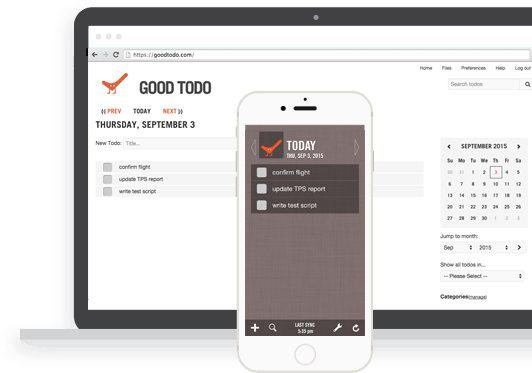
By accepting items through email, Gootodo becomes an active partner in reducing the clutter in your inbox, which allows you to really focus your email activities separately from your time management activities. This lets you feel much less overwhelmed and stressed out, as well as making sure that you are able to find the information that you need and quickly respond to emails. The idea of day-based to do lists instead of a large list with due dates makes the day's work load feel much more manageable.
Very well put.
Try it here, free for one month: Gootodo.com
P.S. Yes, the name... the name. I polled Gootodo users this week - and the consensus is that we need a new name. Working on something short, easy to remember, easy to say, and available in .com. :)
How to halve your emissions
How to cut your emissions in half - good roundup from Treehugger of Graham Hill's Gel 2009 talk (including the video of the talk):
According to Hill, by following his simple "weight loss" plan just one day a week, you can save $1000, lose 10 tons of carbon and be healthier. The tips offered are really fascinating such as how a NY-Bangkok trip generates half of your annual carbon emissions - in one trip! Yikes! So, choosing your plane and combining trips really does impact the emissions your generate. Essentially by becoming a smarter shopper, (food, flying, green power) you can at least cut your emissions in half, which is a bigger impact than just using a canvas shopping bag.
See also: Video of Graham Hill, Treehugger.com founder, at Gel 2009
Notes for building a better restaurant experience: 50 things restaurant staffers should never do
Hertz changes its logo
Hertz, the rental car company, just changed its logo.
I occasionally have fun commenting on companies that spend millions of dollars changing their logo without ever talking to customers.
But this one - if it's true - is really notable. Apparently Hertz conducted customer research - a 25- to 30-minute survey, including live-chat Q&A, according to one person - just to get feedback on the new logo. Just reactions to the graphical change. Not about what being a customer of Hertz is actually like, or why people choose Hertz (or not) over its competitors. Just the logo.
Translation: yes, they did customer research. But no, it still wasn't directed toward improving the customer experience.
What has to happen before large companies take an authentic interest in improving the customer experience? (I'm biased, but I've seen lots of companies dramatically improve their business metrics with some simple, common-sense research.)
A few fun Halloween pointers:
• Chris "in a van down by the river" Farley, on Halloween
• Halloween Health Scare, by Zina Saunders
• Jerry Seinfeld's Halloween memories
• Now on the games list, Plants vs Zombies - a fun casual game for the season.
More in the Good Experience Archives